Before Renee Good was killed, I signed up to be trained as an observer of Immigration and Customs Enforcement activities here. Like so many, I wanted to “do something” about the darkness that’s descending.
I was also pretty sure that I would disappoint myself in the process.
I’m a bookish, introverted writer, better at talking about justice than taking action in its defense. I come up with plans and vows, and they generally mutate into uncomfortable memories of half-measures, or no measures at all.
Still, I signed up for the training. I hunted immigration-advocacy groups and got on their mailing lists. I made vague vows to join demonstrations. But I lacked a plan.
Then Renee was killed, the official lies about her took wing, and the nausea that has gripped so many in our towns gripped me.
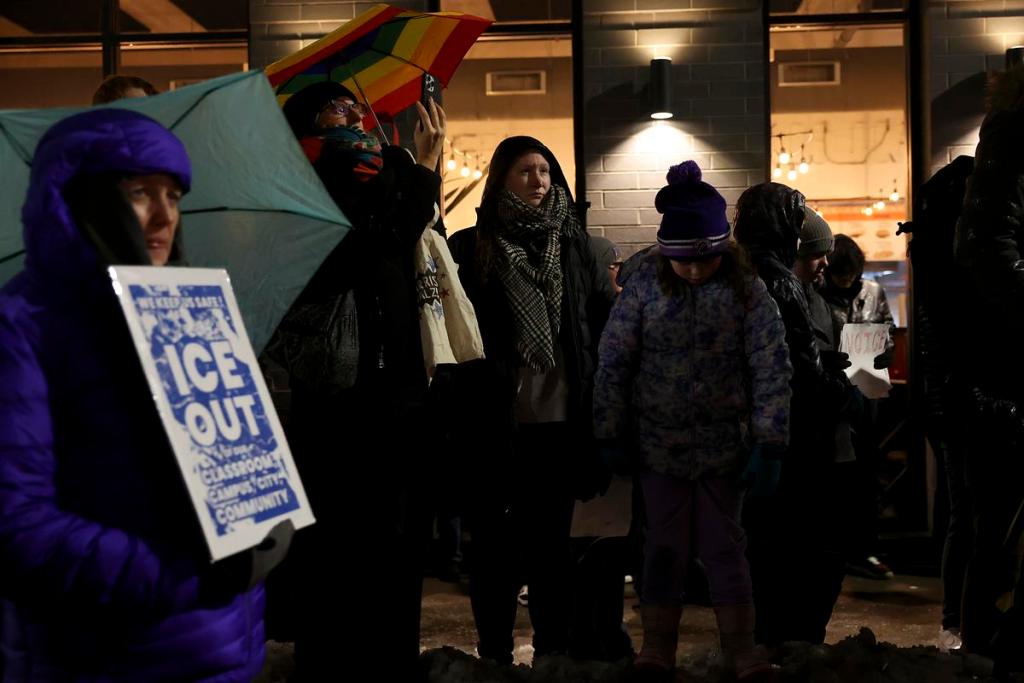
I found myself in a coffee shop, mulling what to do, when I spotted a tall young man all by himself out on the corner in the frigid wind holding a sign that said, “ICE OUT.” Passing cars honked as he swiveled the sign.
That’s what I can do, I told myself. Make a sign, take up the guy’s spot and his work. I don’t have to join anything! It’s an introvert’s way of taking a stand.
A bookstore I frequent was offering free cardboard for anti-ICE signs. I grabbed one, printed out a portrait of Renée, taped it on.
The sign, really just a portrait, sat in my car for a couple of days, while I congratulated myself on having taken these baby steps. I vowed to assume my street corner post on Sunday, Jan. 11, after church.
In church, the priest preached about all of us being called to be prophets. OK, I thought, that’s me today, I guess.
At the back of my mind, however, was the creeping, incoherent sense that I was about to make a fool of myself. I began to worry about how I would look to passing motorists. A paunchy guy in a knit cap, shivering in the wind, clutching a poorly printed image of a woman. Some people would honk. Others might flip me off. I wasn’t afraid, I just didn’t want to court embarrassment. I had walked about halfway from my parking place to the corner, and I was freezing to death.
It was the sort of miasma of self-consciousness, anxiety about difficulty, and nameless unease that always came over me when I left my comfort zone.
I turned back. There were other things I could do. The observer training. The demos. I didn’t have to call attention to myself with this lonely, quirky taking-a-stand.
And yet, I had told myself I would, and I wanted to be able to further tell myself that I had actually done this simple-but-not-easy thing.
The wind picked up. I shivered. I faced my intended corner again. And then I suddenly noticed, on that corner, not one, but three big white signs, in motion. Three people, two women and a man, were waving the signs, waving their hands. The honking that was going on was crazy.
It was, as they say, a sign — a sign that I didn’t have to run away — from my commitment or from myself. I could join them.
I brought my simple, wordless, introvert’s memorial sign to join their gutsy, demanding ones. I did my best to tell them how their willingness to be there had rescued me from my sad old form of solitary self-disappointment.
The three told me that they don’t represent an organization; they’re neighbors — of each other, and of those who are being stolen off our streets to meet quotas and fill for-profit detention centers.
One of the women told me she loved my sign. And she added: “It’s better to do this stuff together, isn’t it?”
We laughed about how we were all waiting for our George Soros checks. I lifted Renee, waved her like a flag.
The trio became my friends; we’re on a group chat now so we can let each other know when we are headed out to do what we can. The man gave me a much bigger piece of cardboard for my next sign. Maybe it will be bolder.
Jon Spayde is a St. Paul–based freelance writer and editor.
The post A simple sign pays tribute to Renee Good and the power of quiet protest appeared first on MinnPost.