In the summer of 2020, at the peak of the unrest following the murder of George Floyd by a Minneapolis police officer, my St. Paul neighborhood was on edge.
Our sense of safety had evaporated overnight, and I recall being particularly concerned about trucks and SUVs without license plates appearing in my neighborhood. They fueled rumors about out-of-town, right-wing instigators intending to terrorize people, and for a few days, like many people, I watched vigilantly on my porch while listening to a police scanner.
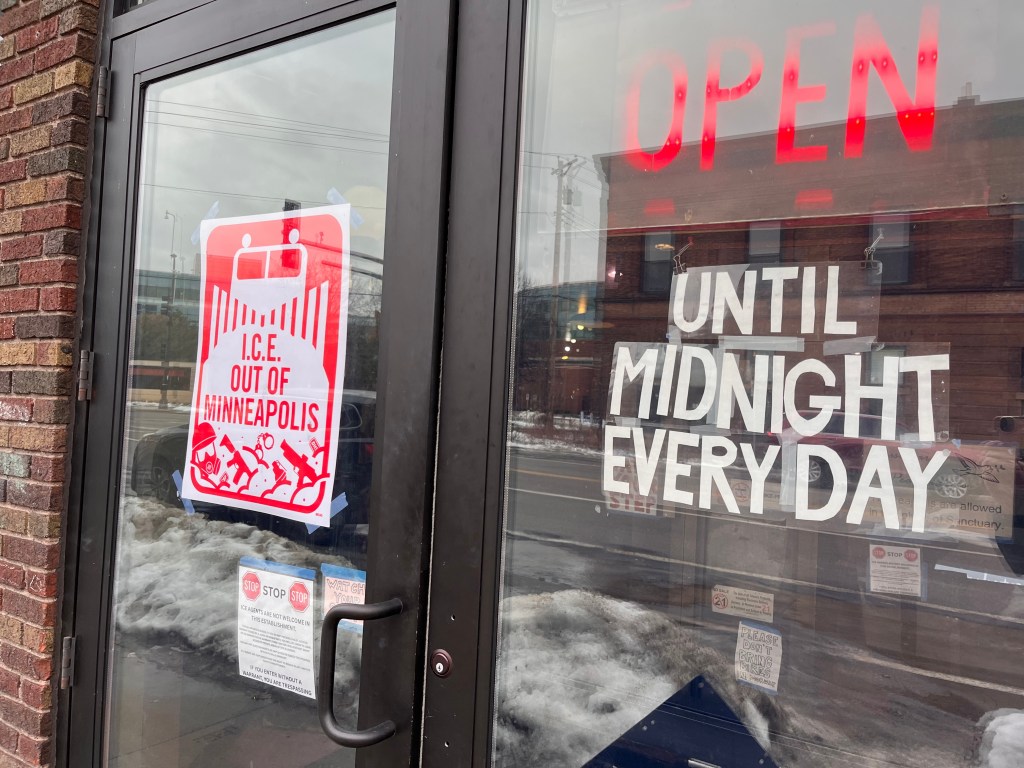
So far, 2026 reminds me of that week. One friend recently described to me how a Karen refugee and mother was taken from her house in our neighborhood. Another neighbor told me how the hole-in-the-wall Mexican restaurant near my house had been the site of a raid where ICE agents abducted two men. ICE agents grabbed cart workers from a Target store. Indigenous people have gone missing. There are a dozen new stories every day.
This moment feels different than 2020 because, back then, something structural had gone off the rails. Internal tensions rooted in racism had come to a head. It was an out of control situation, but a contingent one that, for me, made the eventual sight of the Minnesota National Guard on street corners a relief.
Related: Our visual coverage of the ICE crackdown and aftermath in Minneapolis
This month, the same kind of insecurity is not an accident, but fundamental to a named federal operation sending unaccountable SUVs full of masked men to sow chaos for political propaganda. The ICE officer who killed Renee Good last week was filming himself while doing it, not with a body camera but with his personal cell phone: one hand on a gun, and one hitting record for personal posterity. Much recent Trump-orchestrated activity in the Twin Cities seems similarly oriented to creating “content” to feed a right-wing media machine.
The only meaningful pushback against the terror campaign comes in the form of my neighbors, regular people doing extraordinary and difficult work. They are coordinating themselves from the bottom up, grassroots, using phone chat apps. They are patrolling outside schools and immigrant businesses. They are putting in hours tailing ICE agents, blowing whistles, and witnessing the questionable incarceration of vulnerable neighbors. I know many people who have done this work every day, and I am in awe of their courage.
For better or for worse, the trauma of 2020 prepared many people in the Twin Cities for this moment, pitting armed, well-funded masked men against average people with cell phones and plastic whistles. The only advantages for my neighbors are solidarity, moral clarity and whatever rights remain in this moment.
Related: ‘If I can do it, I’m going to’: How Twin Citians are helping immigrant neighbors
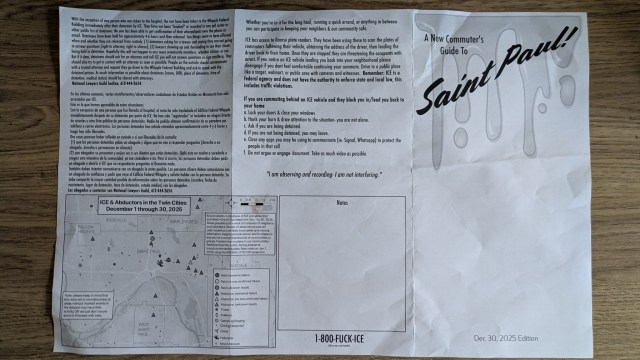
The other day I happened across a paper flyer at my neighborhood bar called “A New Commuter’s Guide to Saint Paul” (Dec. 30, 2025, edition). Inside is a map of the city showing a month’s worth of ICE abductions, along with detailed instructions about where to find missing people (printed in English and Spanish) and tips for what to do if you encounter ICE agents while driving. I wish Renee Good could have read this; it advises people not to roll down their car windows or engage with federal agents — tragic advice given Good’s last words.
The other truth that’s become apparent to me is how fitting the term “sanctuary” looks in retrospect. In architecture, sanctuary refers to protective places, often rooms in churches, that offer the ability to feel humane and reflective. Long used by the immigrant rights community, the political concept of the “sanctuary city” refers to government protections and services offered regardless of citizenship status. In Minnesota, we had been slowly moving toward offering this kind of support, for example by funding driver’s licenses and (for one year, anyway) health care for vulnerable neighbors.
These policies are reasons why ICE is targeting Minnesota. Offering dignity and rights to people fleeing deprivation or government persecution runs counter to the goals of the Trump administration. According to reports, Good and her partner were also seeking refuge, moving to the Twin Cities recently in search of a home where they would not feel like their rights were under attack.
This present occupation does not seem like it’s going to end anytime soon. This federal regime is rarely inclined to change its policies, no matter how destructive, doubling down regardless of on-the-ground reality. The occasional revelations of the haphazard, unprepared nature of the onslaught does little to mollify their guns and technology.
Related: ICE takes Operation Metro Surge into Greater Minnesota
But I know my neighbors will also keep doing this work as long as they have to, and I can only hope we come out of this deliberate tragedy stronger and more unified. The concept of “eyes on the street” refers not only to neighbors on the watch, but the general idea that true security derives from the people themselves, rather than any outside force.
I’m reminded of the words of one of my political and moral guides, Rebecca Solnit, who wrote about how people come together in a disaster. In her book’s case studies, she refers mostly to events like earthquakes and hurricanes, but my hope is that this political situation offers the same dynamics. What people in the Twin Cities are facing today is not a natural disaster or engineering malfunction, but human decisions based explicitly on political retribution amounting to a de facto military occupation.
It’s a cliché to point this out, but Solnit’s thesis is not unusual in Minnesota. We all have stories about blizzards bringing people together. We’ve all been the receivers and givers of help, at minimum pushing stuck cars out of the ice and snow. People here with little else in common routinely come together, shoulder to shoulder, to help each other.
A friend of mine is a pastor at a South Minneapolis church who recently told a story about witnessing a single individual with a whistle who relentlessly used it as two masked agents tried to grab a man pumping gas at a service station. As my friend watched, the whistling worked, and the men in the ICE SUV drove away empty-handed.
He wrote:
“You’ve probably seen the videos of agents saying to protestors and legal observers, ‘You saw what happened. Didn’t you learn your lesson?’ The only lesson learned is the love for our neighbors is growing three sizes each and every day.”
The sign outside my friend’s church now reads: “Blessed are the Whistle Blowers, for they play the Music of Salvation.”
The post The ICE occupation, unlike the aftermath of George Floyd’s murder, is an intentional disruption appeared first on MinnPost.