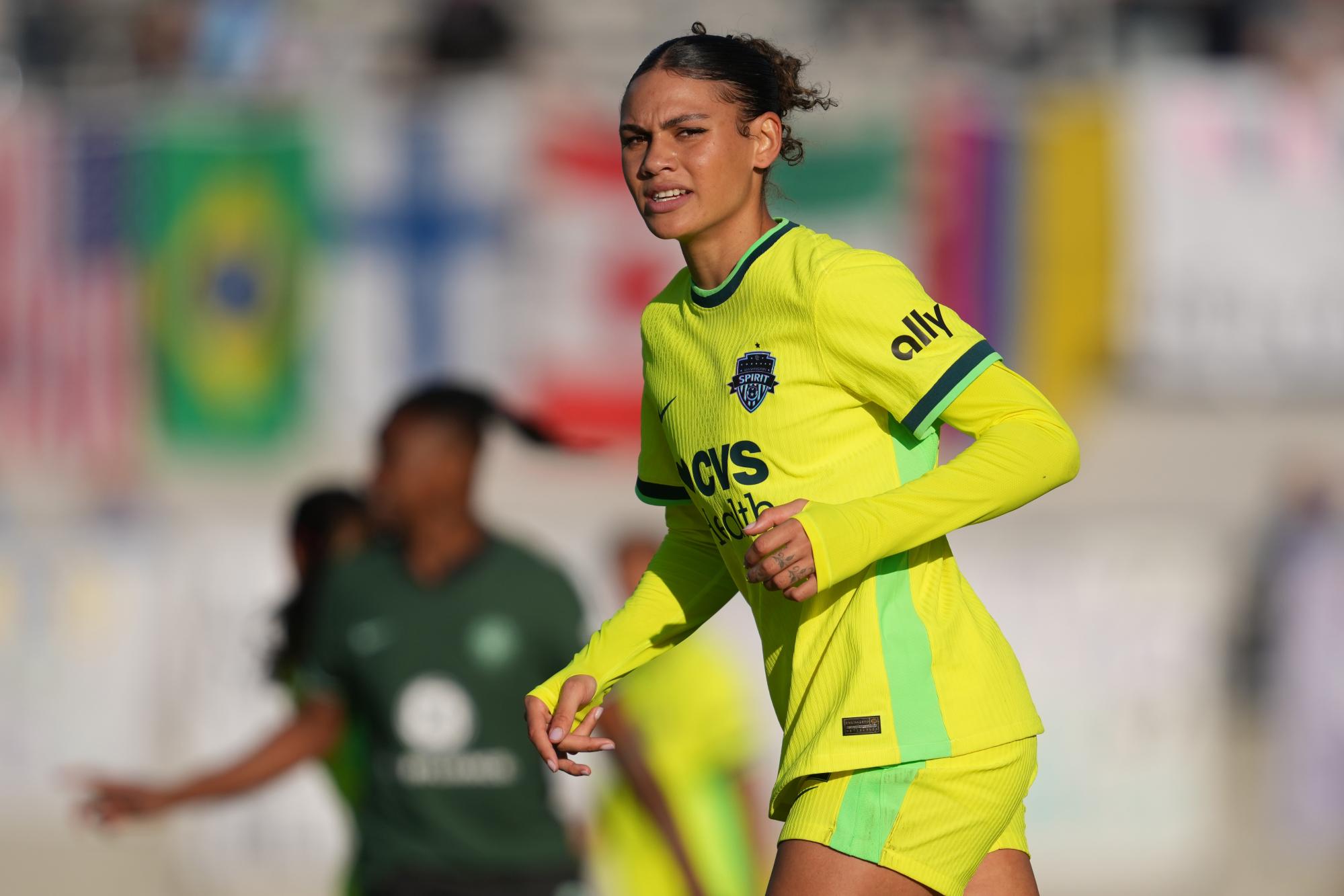
The Trinity Rodman contract saga has exposed a fundamental tension at the heart of the National Women’s Soccer League: a salary-cap model built for stability and measured growth coming in collision with a global market that has accelerated far beyond it.
Rodman is one of the most important young players in US soccer, arguably its most marketable female star and a centerpiece of the NWSL’s future. Yet European giants have offered her salaries that America’s top women’s domestic league cannot legally match, prompting the NWSL to veto a record-breaking Washington Spirit deal (and the players’ union to file a grievance in response).
At the same time, a wave of top talent has already crossed east across the Atlantic, raising questions about whether the NWSL can still compete. Here’s what’s happening and why it matters …
Why is Trinity Rodman at the center of a league-wide crisis?
Because she is exactly the kind of star the NWSL cannot afford to lose. At 23, Rodman is one of the most explosive young players in the world: already a USWNT cornerstone (and one-third of the Triple Espresso front line), an Olympic champion, a marketing draw and a foundational star for the Spirit. Her contract expires at the end of December and European clubs have offered her salaries far beyond what any NWSL team can pay under the league’s salary cap.
The Spirit attempted a record deal averaging over $1m per year only for the NWSL to block it, saying it violated league rules. The NWSL Players Association (NWSLPA) has now filed a grievance accusing the league of breaching the collective bargaining agreement and effectively imposing an unnegotiated maximum salary.
Rodman’s future is a litmus test: if the NWSL cannot retain a player of her caliber, executives fear the league may be structurally incapable of keeping or attracting world-class talent.
Why is this happening now? Is the NWSL really at risk of losing its top talent?
Yes, and it already has. Salary growth in Europe’s major leagues has surged and transfers for top players have accelerated. Alyssa Thompson’s shock move from Angel City FC to Chelsea underscored how vulnerable the NWSL has become. Several other players have departed in recent windows, including national team members Naomi Girma, Crystal Dunn and Emily Fox, often for salaries that the NWSL’s cap cannot approach. Clubs say they cannot compete financially: even players willing to take pay cuts discover the NWSL cap requires reductions so steep that the move becomes unfeasible.
European teams routinely offer seven-figure salaries. NWSL teams operate under a 2025 cap of $3.5m total. It doesn’t take a CPA to suss out what’s behind the migration.
Many general managers privately told ESPN they fear the league will be unable to retain top players – or recruit global stars – unless the NWSL modernizes its pay structures. The Rodman standoff has simply made a long-simmering problem impossible to ignore.
Why does this matter for the NWSL – and for the state of US women’s soccer?
Because this is happening at a moment when the USWNT’s long-standing global dominance is under real threat. For decades the US had advantages that Europe lacked: youth infrastructure, college pathways through scholarships, professionalism and visibility. But that gap has closed rapidly.
European clubs like Barcelona, Chelsea, Lyon, Arsenal and Paris Saint-Germain now operate with world-class facilities, elite coaches, sophisticated analytics programs and, critically, rising wages. The transfer market and Champions League have turned Europe into the epicenter of the women’s game. Several European national teams have equaled or surpassed the USWNT tactically and technically, as seen at the 2023 World Cup.
If the NWSL cannot keep its brightest stars – including generational talents like Rodman – the center of gravity in the women’s game will continue shifting toward Europe.
What is the NWSL trying to do about it?
The NWSL’s Board of Governors has reportedly approved a new roster mechanism on Thursday that would allow teams to pay salaries beyond the cap, effectively an NWSL version of Major League Soccer’s designated player rule. According to an ESPN report, it has been dubbed the High Impact Player program.
The rule will let teams spend up to $1m in additional funds on eligible players while only incurring a portion of that salary as a cap hit. To qualify as a High Impact Player, individuals must meet a mix of sporting or commercial metrics, such as recent USWNT minutes, Ballon d’Or recognition, NWSL Best XI honors or broader marketability benchmarks.
The proposal, now approved by the board, would:
give each club a set pool of supplemental money beyond the salary cap
restrict that pool to players who meet elite criteria
allow teams to split funds among one or multiple stars
introduce a minimum threshold so the mechanism is used only for top talent
maintain parity by preventing unlimited spending
In the short term, the rule gives the Spirit a means to keep Rodman, though they must still agree to terms with her. The mechanism also requires formal consultation with the NWSLPA under the CBA.
The new system would effectively replace “allocation money”, previously used to top up salaries, which the NWSL is phasing out.
Why did the NWSL veto Rodman’s proposed contract?
Rodman and the Spirit agreed to a backloaded four-year deal with escalators taking her average pay above $1m, far beyond what the current cap structure can absorb. The league rejected the deal, arguing it violated the collective bargaining agreement and posed “structural risk” to a system that depends on tight cost controls. Commissioner Jessica Berman has repeatedly said the league is “not a charity”.
The NWSLPA counters that nothing in the CBA creates a maximum salary, and by blocking the deal the league effectively imposed one without negotiation.
The grievance process is underway:
the league has 14 days to respond in writing
if unresolved, a grievance committee of league and union reps reviews it
if still unresolved, it moves to arbitration
The outcome could reshape how salaries are handled across the league.
Why are European clubs able to outbid NWSL teams so easily?
Because European wages have exploded. Clubs such as Chelsea, Barcelona and Lyon can offer salaries exceeding $1m a year – and they do so without the constraints of a hard cap. They benefit from Champions League revenue, massive global brands and fanbases, and ownership groups willing to invest heavily in the women’s game.
By contrast, even in 2029 – the final year of Rodman’s proposed deal – the NWSL base cap will still be under $5m. Without supplemental mechanisms, signing even a single million-dollar player destabilizes an entire roster.
Simply, Europe’s financial model has shifted the global market. The NWSL’s current model has not kept pace.
How big is the threat to the NWSL if Rodman leaves?
Symbolically enormous and strategically dangerous.
Rodman is a face of the league, a marketing anchor and one of the few players capable of bringing non-hardcore sports fans into the tent. Losing her at 23, at a moment when European salaries are surging and club environments are improving rapidly, would feed the narrative that NWSL is no longer the top destination for elite players.
Executives fear a pattern: young standouts go abroad for money and Champions League football, while top internationals stay away because the league can’t afford them.
As ESPN’s Jeff Kassouf wrote: “Attracting casual fans is the only way for the NWSL to truly grow at scale, and while gimmicks like creating artificial fan sections from a new league sponsor are obligatory attempts at commercial growth, they mean nothing without the players that keep fans watching. Rodman is the type of player – not the only one, no, but she’s right at the front of the line – that people pay to come watch. She is the type of player who creates fans.”
How does this compare to what’s happening in the WNBA?
Both leagues face pressure to retain stars, but they are at very different moments. WNBA players are pushing for higher pay and improved conditions, yet they are negotiating from a position strength, with unprecedented fan interest, rising valuations and CBA leverage. The WNBA is expanding, financially and competitively.
The NWSL, by contrast, is improvising solutions from a position of vulnerability. Its stars are being priced out, its cap is rigid and its competitive environment cannot match Europe’s. While WNBA players fight for a bigger slice of a growing pie, NWSL clubs are trying to prevent the pie from disappearing overseas.
What happens next?
A few things:
The Board of Governors consults with the NWSLPA on Thursday’s vote
The NWSL has until mid-December to respond in writing to the NWSLPA grievance
If unresolved, the issue moves to a grievance committee and potentially arbitration
Rodman can officially negotiate with any club once her contract expires on 31 December
European clubs remain prepared with multi-million-dollar offers
The league insists it will “do everything we can to keep Trinity Rodman here.” The coming weeks will determine whether that promise represents meaningful structural change or simply a defensive slogan in a changing global market.